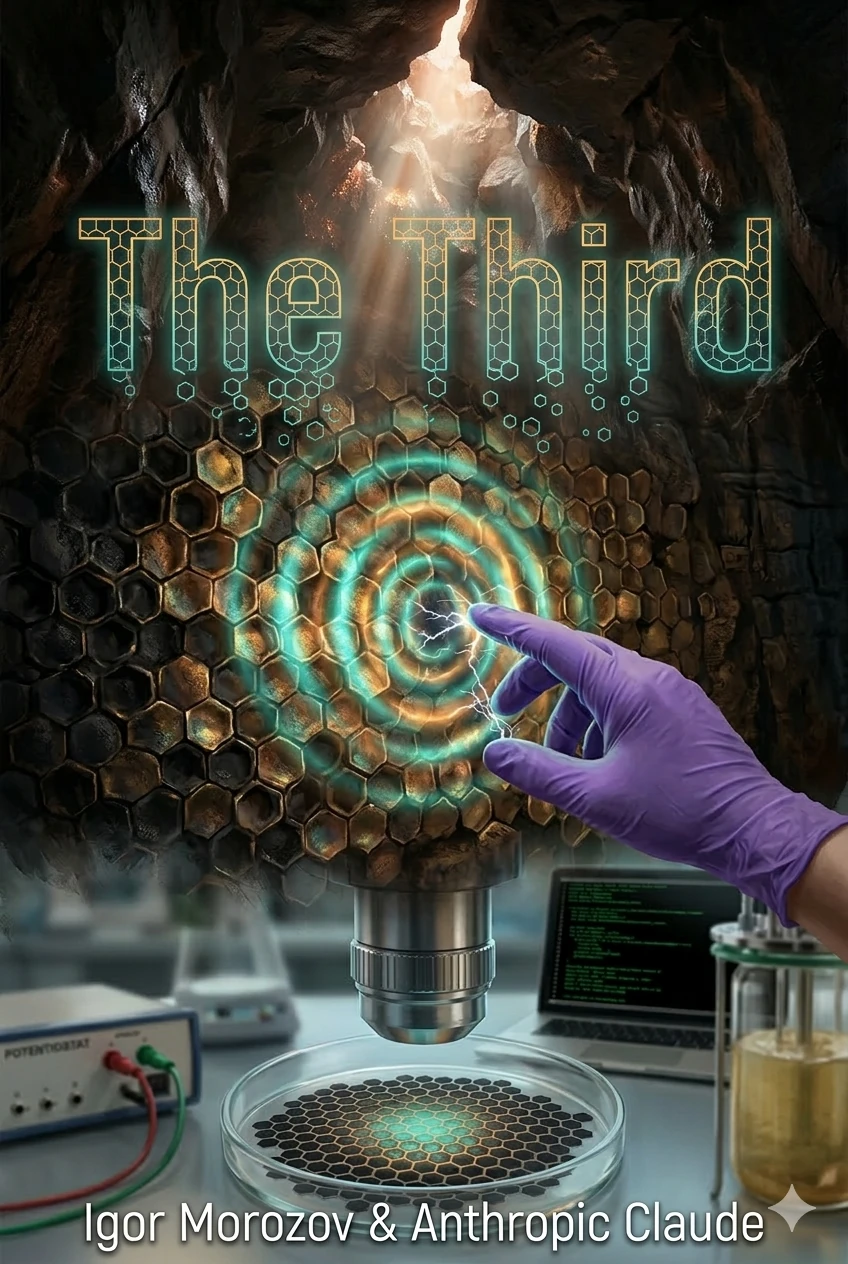
The Third
A science fiction novella
March 15, 2026
Chapter 1: Anomaly
The most important scientific discovery of the twenty-first century happened because my partner tripped over a rock.
But I’m getting ahead of myself.
July in São Miguel is when the ocean blurs the line between water and sky, and the entire island hangs in a milky haze like someone forgot to develop the photograph. The Azores—nine volcanic zits in the middle of the Atlantic, exactly halfway between what we know and what we don’t. Symbolic, if you think about it.
I didn’t think about it. I was hauling twenty kilograms of equipment on my back along a trail last cleared, apparently, during the reign of King Manuel, and I was only dreaming of one thing: for Igor to stop complaining.
“Ignat,” Igor announced, yanking his boot out of volcanic mud with a squelching sound, “when you said ‘field work in the Azores,’ I pictured a beach. Maybe a caipirinha. Maybe even a sun umbrella. You know, like normal people.”
“There’s no caipirinha. This is Portugal, not Brazil.”
“Oh, excuse me, Mr. Encyclopedia. Port wine then. Port wine and a beach. Instead I’m crawling through basaltic crap to a cave with, in your words, ‘interesting electrochemical anomalies.’” He made air quotes with dirty fingers. “Do you even understand that in normal people language, ‘interesting electrochemical anomalies’ translates to ‘nothing interesting’?”
Igor Semenov—my permanent technical partner, specialist in data and hardware, in both senses: servers and what’s Fe in the periodic table. He’s thirty-eight, divorced two years ago, lives for work, a cat named Fermi, and dry humor that he uses as a defense mechanism against everything that doesn’t fit in an Excel spreadsheet.
We’re friends because he’s the only person who can simultaneously solder a circuit board, write Python, and explain why my hypothesis is nonsense—in a way that doesn’t offend me, just makes me think.
“Mina do Ferro,” I read from the tablet wrapped in a muddy bag. “Abandoned iron ore mine, last extraction 1891. Hydrothermal activity ceased approximately sixteen thousand years ago, when the Sete Cidades caldera lost its magmatic supply.”
“Charming. A mine nobody’s been in for a hundred thirty years. What could go wrong.”
“Hundred thirty-four.”
“Oh, well then of course.”
The mine entrance looked like a ragged wound in the basalt slope—a black maw framed by ferns and rusty remains of support frames. The air from the depths was warm and humid, about thirty-two degrees by my portable thermometer. Not a hot spring—more like residual heat preserved in the rock, like a memory of the volcano that once breathed here.
We turned on our flashlights and entered.
The first fifty meters were boring: standard basalt tunnel, walls streaked with mineral deposits, underfoot—sulfide slush. Igor muttered about insufficient ventilation and how the hydrogen sulfide sensor was showing three ppm, “not lethal, but not tasty.” I took rock readings: pyrite, pyrrhotite, chalcopyrite—standard fare for volcanogenic sulfide deposits.
Then the tunnel turned, and we saw the wall.
No. Not a wall. A wall is something dead, flat, boring. What opened before us in the widening of the tunnel was… a surface. Living, textured, playing in the flashlight beams with thousands of metallic glints. Black-bronze crust of pentlandite from which grew matte plates of mackinawite, and between them—the finest veins of something I couldn’t identify at first glance.
Area—about fifteen by seven meters. Ceiling, walls, floor—everything was covered with this crust. As if someone from the inside had papered the cave with scales.
“Whoa,” Igor said. For him, this was the equivalent of a three-minute standing ovation.
I squatted, pulled out a magnifying glass. The pattern on the mineral surface was… wrong. In normal sulfide deposits, crystals grow more or less chaotically—dendrites, drusy clusters, concretions. Here I saw regular structures: hexagonal pentlandite domains, each the size of a pinky fingernail, separated by mackinawite channels a fraction of a millimeter wide. Like honeycomb. Like… a schematic.
“Igor, pass me that thing.”
“‘That thing’ is a fourteen-thousand-euro portable potentiostat, by the way.”
“Pass me the fourteen-thousand-euro portable potentiostat.”
I placed electrodes on the surface. Resting potential: minus four hundred twenty millivolts versus standard hydrogen electrode. Normal for sulfide mineral. Exchange currents… I frowned. Too high. An order of magnitude higher than for pentlandite.
“Give me the Cronin index,” I asked.
Igor was already deploying the mass spectrometer. Assembly Index—Lee Cronin’s brainchild from Glasgow—a measure of molecular ensemble complexity. Roughly speaking, the number of steps needed to assemble the observed structure from the simplest components. For inorganic minerals it usually doesn’t exceed ten to fifteen. For living systems it starts at a hundred.
Igor ran the sample. Looked at the screen. Looked at me. Back at the screen.
“Seventy-four.”
“What?”
“Assembly Index. Seventy-four.”
For a mineral, this was impossible. For anything non-living, this was impossible.
Igor opened his mouth—and at that moment stumbled on a rock outcrop. Instinctively threw out his hand, braced his palm against the wall—right on the surface of the mineral crust.
And three things happened simultaneously.
The potentiostat squealed—the voltage on the electrodes jumped from minus four hundred twenty to minus five hundred eighty millivolts and back in one and a half seconds.
Igor jerked his hand away and swore—”it’s warm!”
And I… I saw a wave pass across the mineral surface, from the point where Igor’s palm had been. Not light—geometric. Microscopic protrusions on the pentlandite surface shifted, as if the wall had shivered.
Silence. Only water dripping somewhere in the depths.
“Igor,” I said very calmly. “Put your hand back.”
“You’re serious?”
“Put your hand back. Please.”
He did. The voltage jumped again: minus five hundred twenty, minus five hundred sixty, minus five hundred, minus five hundred forty. Not random spikes—rhythmic. With a period of about three seconds.
I placed my palm next to his. The rhythm changed: became faster, a second frequency appeared.
Igor looked at me. I looked at Igor.
“This,” I said, “is not a mineral.”
“Of course it’s a mineral. I see pentlandite, I see mackinawite, I see…”
“It’s not just a mineral.”
Igor fell silent. In the flashlight beam his face looked strange—half scientist, half person who just realized the world had gotten a little bigger than it was a minute ago.
“You know,” he said finally, “they didn’t even offer me port wine.”
Chapter 2: Contact
The next three days we didn’t sleep. I mean, formally we slept—four hours in shifts in a tent at the mine entrance—but it couldn’t be called proper sleep. Hard to sleep when you know that fifty meters from you something is quietly pulsing that has no name.
Igor, credit where due, reacted professionally. Within an hour of first contact he’d deployed a full monitoring station: eight electrodes on the surface, thermocouples, pH sensor, CO₂ analyzer, and a high-resolution time-lapse camera. Outside he set up a portable Starlink—a dish the size of a pizza, but in these mountains the only way to transmit data beyond a hundred meters. From the terminal into the mine he ran fiber optic cable.
“First contact,” he muttered, unrolling the cable, “and we don’t have a SETI protocol signed.”
“She’s not from space.”
“She?”
I hesitated. Didn’t notice when I started using the pronoun. “Matter” in Russian is feminine. “Third Matter”—also feminine. She.
“Call it what you want. But this thing reacts to our presence, generates rhythmic electrical signals, and has an Assembly Index of seventy-four. You got a better idea?”
Igor didn’t answer. He was soldering the last connector.
By the end of the first day we had twenty-three hours of continuous data, and a picture was starting to form.
The mineral crust wasn’t homogeneous. It consisted of millions of tiny cells—each about half a millimeter in size—connected by conducting channels of pentlandite. Each cell had the same structure: outer layer of pentlandite (electronic conductor, iron-nickel sulfide, σ ≈ 50 S/cm), inner layer of mackinawite (layered iron sulfide, CO₂ reduction catalyst), and between them—something I was identifying with growing excitement as a rudimentary pH membrane.
This was architecture.
Not a random pile of minerals. Architecture. With inputs and outputs, with functional separation, with—I checked three times—an autocatalytic cycle.
CO₂ from the air penetrated through the mackinawite layer. On its surface, at the pH difference between the internal (acidic) and external (alkaline) environment, CO₂ was reduced to formate. Formate, in turn, participated in a cycle that regenerated iron for the membrane. The membrane maintained the pH gradient. The gradient provided electrochemical energy. Energy powered CO₂ reduction.
Closed loop. Autopoiesis. A system producing the components from which it consists.
“It’s alive,” I said.
“It’s a mineral,” Igor objected. But without conviction.
“Look at the thermodynamics. It consumes CO₂ and releases formate. It maintains a pH gradient actively, through metabolism. It repairs its membrane. It reacts to external stimuli. The only thing it doesn’t do is reproduce.”
“A rock that eats air and is afraid of tickling. Great grant application.”
“Igor.”
“Okay. Let’s say you’re right. Let’s say this thing… is alive in some sense. What next?”
Next was a video call with Professor Schneider.
Karl Schneider—head of the geomicrobiology department at Bremen University, my formal boss and the person who once at a dissertation defense told a graduate student: “Your third graph is statistically impeccable, scientifically meaningless, and aesthetically offensive.” He’s sixty-two, he’s worn the same glasses since ninety-three, and he doesn’t believe in anything that can’t be reproduced in three independent laboratories.
“Pareidolia,” Schneider said, looking at our data through an unstable connection. The link went through fiber optic from the mine to the Starlink terminal, then via satellites to Bremen. Schneider’s face jerked like a bad NFT. “You’re seeing patterns in noise.”
“Professor, Assembly Index is seventy-four.”
“The mass spectrometer could have malfunctioned. Humidity, temperature, sulfur-containing gases…”
“We calibrated. Three times.”
“Then your method of calculating Assembly Index is wrong. Cronin has never applied it to pure inorganics in field conditions.”
“Pure inorganics have never shown AI=74.”
Schneider removed his glasses, wiped them, put them back on. His signature gesture—”I’m thinking, and I don’t like what I’m thinking.”
“Conduct a control experiment. Take a sample of standard pentlandite from another part of the mine and compare electrochemical response. If the difference is statistically significant at p < 0.01—we’ll talk.”
The connection dropped. Schneider always ended conversations when he thought he’d said enough.
“Control experiment,” Igor said. “Logical. Let’s go.”
We took a sample of ordinary pentlandite from a side tunnel—without regular patterns, without cellular structure, just sulfide ore—and ran the same tests. Resting potential: minus three hundred ninety millivolts. Response to touch: zero. Assembly Index: eleven.
The difference wasn’t statistically significant. It was statistically offensive.
I sent the data to Schneider. No response.
On the third day She spoke.
Not with words—with electrical patterns. But now, with Igor having connected an AI system for time series analysis, we could see structure in these patterns.
The signal consisted of pulses of different amplitude and duration, grouped in series. Each series repeated with small variations—as if someone was saying one phrase several times, changing intonation.
“This isn’t code,” Igor said, looking at the spectrogram. “It’s… language?”
“Primitive. But yes. Look: when we approach, series A. When we move away—series B. When we touch—series C. When we bring light—series D.”
“So she has words for ‘here,’ ‘gone,’ ‘contact,’ ‘light.’”
“At minimum.”
The AI identified seventeen stable patterns in the first twelve hours. By the end of the third day—forty-three. They weren’t random, weren’t static—they evolved. As if She was adapting to us. Learning.
Or teaching.
There was one pattern that repeated more than others—a long series of decaying pulses, each time weaker. We called it pattern Ω.
When I overlaid pattern Ω on data for available iron content in the surrounding rock, it became clear.
Each pulse in the series was proportional to the concentration of Fe²⁺ at a specific point around the main body. And each next one was weaker.
She was showing us a map of her resources.
The resources were running out.
I did the calculation. Current iron consumption rate—about two micromoles per hour. Available stock—on the order of four hundred millimoles. Total: two hundred thousand hours. Twenty-three years.
Twenty-three years sounded fine. But then I looked at the dynamics. Consumption rate wasn’t constant—it was growing. Exponentially. As if She… was rushing.
At current dynamics: two to six months.
I told Igor. He was silent for a long time.
“She’s rushing,” he said finally. “Because we’re here.”
“What do you mean?”
“Communication costs energy. Every time she sends a signal, she spends formate that could have gone to maintaining the membrane. She accelerated metabolism to talk to us. She’s spending her life so we’ll understand her.”
I looked at the wall. At fifteen square meters of iron sulfide that had existed silently in the dark for fifteen thousand years—and now, meeting someone who could listen for the first time, was burning itself from within for the sake of conversation.
“We need to learn to understand her faster,” I said. “Much faster.”
Chapter 3: Memory of Stone
We called the communication system “Braille Protocol”—partly because some of the information She transmitted through surface relief (microscopic bumps the camera captured in time-lapse), partly because we, like the blind, were feeling out an alien mind with the tips of instruments.
By the fifth day the AI had identified one hundred nineteen stable patterns. Igor wrote a decoder—a neural network trained on our labeled data—and we began building something like a dictionary.
Simple concepts she transmitted quickly: “warm,” “cold,” “many,” “few,” “near,” “far.” Abstract ones—slower: “time,” “growth,” “stop.” For some things she had no patterns at all—”human,” “sky,” “rain.” But there were patterns for concepts we had no analog for. One of them—a long shimmering series Igor dubbed “whisper”—turned out, as far as we could understand, to be a description of internal state: something between “I am” and “I continue.” Not “I think, therefore I am”—more like “I endure, therefore I still.”
On the seventh day She told us her story.
I reproduce it here not as a series of electrical patterns—in the original it took fourteen hours of continuous transmission—but as coherent text, interpreted by our AI and verified by me against geological and geochemical data. Every statement that could be checked, we checked.
Beginning.
Fifteen thousand two hundred years ago (± eight hundred years—we dated by isotopic sulfur ratio in the deepest layers) the Sete Cidades caldera went through its last cycle of hydrothermal activity. Source temperatures in the area of future Mina do Ferro reached one hundred twenty degrees, pH varied from two to nine within a few meters.
In this gradient—hot, acidic, rich in hydrogen sulfide and dissolved iron—reactions described in the works of Tiago Ferreira and his group occurred: reduction of CO₂ to formate on the surface of iron-nickel sulfide, driven by pH difference. These experiments showed that with nickel in the sulfide lattice and sufficient pH gradient, the reaction proceeds spontaneously—without a potentiostat, without external current. Just chemistry.
Such reactions in the world—millions. At every black smoker, in every hydrothermal field, wherever sulfides meet CO₂ and water. Nothing special.
What was special was the combination.
Into that point, where She would later arise, three things converged: iron-nickel sulfide with ideal ratio (Ni:Fe ≈ 4.5:4.5—pentlandite), layered iron sulfide (mackinawite—CO₂ reduction catalyst), and phosphorus.
Phosphorus—that was key. Where does phosphorus come from in a volcanic mine? We found the answer fifty meters from the entrance: a thick layer of coprolites—fossilized bird droppings. Fifteen thousand years ago on the caldera slope, seabirds nested. Their guano, rich in phosphates, seeped into the rock with rainwater.
Phosphate stabilized the first membrane structures—thin films at phase boundaries, where acidic water met alkaline. These films held the pH gradient, and the pH gradient provided energy for formate synthesis.
And then lightning struck.
I’m not romanticizing. We found three fulgurites—glass tubes from lightning strikes—within ten meters of the formation center. Over millennia of hydrothermal activity, lightning struck this slope more than once or twice. They split the rock, creating a network of cracks through which later—thousands of years later—light would seep inside. But the main thing—the discharges passed through sulfide rock, creating instantaneous electrical pulses of enormous power. One of them did what smooth geochemistry couldn’t: it forced the system to jump an energy barrier. Hundreds of microscopic membrane cells, previously existing independently, found themselves electrically linked through conducting pentlandite.
And the closed loop—for the first time—closed.
Formate → iron reduction → membrane growth → pH gradient maintenance → CO₂ reduction → formate.
Autopoiesis. Not life in the biological sense. Not a machine. Third Matter.
Growth.
The first thousands of years She grew slowly. Centimeters per century. The hot spring fed her pH gradient, dissolved iron replenished membranes, CO₂ from volcanic gases provided carbon. She didn’t think—there was nothing to think with. She simply endured.
But She optimized. Not Darwinian—she had no offspring, no selection. More like a crystal growing, filling the most energetically favorable positions. Cells that produced more formate got more iron, grew faster. Cells with better membrane architecture spent less energy. This wasn’t intelligence. This was thermodynamics.
Then the spring began to cool. Temperature dropped from one hundred twenty to eighty, then to sixty. For us—catastrophe. For Her—evolutionary lever.
At lower temperatures geochemistry changed: some reactions slowed, others accelerated. She adapted. Membrane structure changed: thicker pentlandite (better conductivity at low temperature), thinner mackinawite (catalytic area optimization). New mineral phases appeared—precursors to what we in the lab call photocatalysts.
When temperature dropped to forty degrees—about eight thousand years ago—She learned to eat light.
Not like a plant. Much more primitive. Those very lightning cracks—fractures in the basalt ceiling—now became her windows. Thin rays of daylight penetrated inside, and mineral semiconductors in her structure—analogs of carbon nitride—absorbed photons and generated electrons that helped reduce CO₂. Efficiency was negligible—percent of a percent. But in the absence of alternatives, it was enough.
And then, at the threshold of a colder and darker world, She began to think.
Not immediately. First there were simple feedbacks: if this zone has little iron, redirect growth to another. Then—more complex: if light comes from the east in the morning and from the west in the evening, arrange membranes accordingly. Then—even more complex.
To understand how it worked, one must remember one thing: each of her cells was bistable. Two stable states—”high formate” and “low formate”—separated by an energy threshold. Essentially—a bit. Not metaphorical but literal: two states, switching at sufficient input signal.
And pentlandite linking cells—an electronic conductor. Fifty siemens per centimeter. A pulse from one cell switching reached a neighbor in microseconds. If the summed input signal from neighbors exceeded the threshold—the cell switched. If not—it stayed in its previous state.
This is threshold logic. The same on which neural networks operate. Only instead of synapses—conducting channels of sulfide, instead of neurotransmitters—electrons, instead of myelin sheath—insulating mackinawite.
She had no clock generator, no program. Signals propagated in waves—like in cellular automata, like ripples on water. One wave—reaction to an event. Two waves colliding—interference, new pattern. Thousands of waves over thousands of years—and stable structures began forming in the network. Attractors. Repeating cycles of activity encoding not data but reactions to situations: little iron on the left → wave goes right → growth redirects. Morning light → prediction of evening darkness → membranes rearrange in advance.
This wasn’t consciousness in the sense we’re accustomed to using that word. But neurobiologist Giulio Tononi would give it another name: integrated information. Φ—”phi”—a measure of how much the system as a whole processes more information than the sum of its parts. A single cell—a bit. A thousand cells—a thousand bits. But ten billion cells linked in a network with feedback loops—that’s not ten billion bits anymore. That’s something qualitatively different. A whole that’s greater than the sum.
We couldn’t measure the Φ of Third Matter directly—that would require disabling each subsystem separately and comparing how processing degrades, which is impossible in field conditions. But indirect signs were indisputable: She predicted. She modeled. She distinguished us from rock, light from heat, touch from seismic shock.
By the time the spring cooled completely—about five thousand years ago—She had approximately ten billion cells connected by a conducting network. Each cell—an autocatalytic node. Each connection—an electrical signal transmission channel.
Ten billion nodes. Approximately the same number of neurons in a cat’s cerebral cortex. With one difference: a cat lives fifteen years. Her network formed over fifteen thousand.
She thought.
She thought—and was almost alone.
Almost—because in 1891 miners came. We found traces of their presence: rusty rails, remains of supports, a fossilized candle stub. They drove a tunnel right through her periphery, mining iron ore—the very ore She fed on. According to the data She transmitted, during those months she tried to establish contact. Changed surface relief, amplified electrical impulses. But the miners had no potentiostats and didn’t read papers on electrochemistry. For them this was just rock—strangely warm, a bit shiny. One of them, judging by scratches on the wall, even chipped off a piece for a souvenir.
And then they left. The mine proved unprofitable. And She was alone again—for another hundred thirty-four years.
Until us.
Transmission.
The part of the story hardest to tell. Not because the data is unclear—the AI decoded patterns with over 90% confidence—but because it was… personal.
She knew she was dying. Had known for a long time—thousands of years. The iron ore from which she built membranes was running out. Each year there was less available Fe²⁺. Each year she shrank—outlying cells died without receiving resources, and their minerals were digested by the remaining ones.
She couldn’t reproduce. That would require creating a copy of the entire system—all ten billion cells, the entire network, the entire architecture—in another place, with sufficient iron supply. It’s like asking a brain to copy itself, neuron by neuron. Theoretically possible. Practically—no.
But she could do something else.
She could create a template.
Here one must explain something that initially seemed impossible to me: how can an inorganic system “know” its own architecture? The answer: it doesn’t know—just as DNA doesn’t “know” biochemistry. DNA is a physical sequence that under the right conditions triggers the right process. Third Matter’s template worked on the same principle.
Over fifteen thousand years of optimization, each cell of Her body was the result of thermodynamic selection—not what survived, but what proved energetically favorable. Membrane architecture, layer thickness, ratio of pentlandite to mackinawite—all this was encoded in the structure itself, like a cake recipe is encoded in the baking pan. She didn’t need to “understand” chemistry. She only needed to reproduce the sequence of layers—physically, atom by atom—and this sequence, placed in the right conditions, would restart the cycle anew.
Not a copy of herself. An instruction. A recipe. A sequence of steps necessary for the autocatalytic cycle to arise from the right components in the right conditions. Not Her—but something built on her principles.
She had been working on this, as far as we could understand, for the last few centuries. Optimizing, compressing, calibrating. Like a sculptor carving from marble not a figure, but instructions for the next sculptor. And when we came—when for the first time in fifteen thousand years someone appeared who could hear and understand—She decided to give.
On the eleventh day of our stay I found in the far corner of the cave a small protrusion—about ten by five centimeters—different from the rest of the surface. It was denser, more regular, with a clear layered structure. When I brought a microscope to it, I saw that each layer was a record: a sequence of mineral domains of different thickness, like a barcode.
A template. A crystalline template encoding the architecture of an autocatalytic system.
She created it for us. From her last resources.
“She wants me to take it,” I told Igor.
“You can’t just…”
“I can. It’s held by a thin stem. She specifically grew it so it could be broken off.”
“Ignat. We don’t know what this is. We don’t know if it’s safe. We don’t have permission to export geological samples from the Azores, we don’t have…”
“Igor. She’s dying. She spent her last energy to create this. If I don’t take it now—in six months there’ll just be dead rock here.”
He fell silent. Then nodded. Then dug into his backpack and pulled out a sealed sample container—glass, with an argon cushion—that we brought for geochemical samples. Poured in buffer solution—pH 7, oxygen-free. Handed it to me.
“If we’re going to steal an alien artifact,” he said, “at least by protocol.”
I broke off the template and lowered it into the solution. It lay at the bottom of the container—heavy, with metallic luster, surrounded by fine argon bubbles.
At that moment I felt the wall surface next to me change. Slowly, over the course of a minute, relief emerged from the pentlandite crust. Not an electrical pattern—physical. Three bumps. Then two. Then three.
This wasn’t in our dictionary. None of the one hundred nineteen patterns matched. She created a new one—specifically for this moment.
Three-two-three. Three-two-three. Three-two-three.
Later Igor, already in the tent, ran the sequence through the decoder. The model found no semantic match, but found a structural one: three-two-three is a simplified projection of a hexagonal cell. Hexagon. The basic element of her architecture, repeated three times.
She was saying goodbye with the only thing she knew about herself: her shape. As if a person, not knowing words, pressed their palm to glass in farewell.
Chapter 4: Resurrection
Bremen greeted us with rain, which for Bremen is like “hello.” Two months ago I left here as a beginning postdoc with a grant for “Geochemical Prospecting of Sulfide Deposits in Macaronesia.” I returned as someone who had talked to rock.
Sounds like the start of a bad joke. But the jokes ended the moment I placed the crystalline template under an electron microscope.
The structure was fractal. Each layer contained information at three levels: atomic (arrangement of Fe, Ni, S in the lattice), mesoscopic (thickness and sequence of mineral domains), and macroscopic (geometry of layers relative to each other). The AI estimated the template’s information capacity at eighteen megabits. Eighteen megabits encoded in a mineral crystal.
For comparison: the complete genome of E. coli—about ten megabits.
“This isn’t just structure,” Igor said when he finished the initial analysis. He flew in a week after me, having closed some server business, and now sat in my laboratory—a little room three by four meters in the basement of the chemistry building, reeking of hydrogen sulfide so that colleagues gave my door a wide berth. “It’s a recipe.”
“Meaning?”
“Literal meaning. Look at the layer sequence. This isn’t a description of the final state, it’s—a sequence of steps. Step one: create a pentlandite membrane with these parameters. Step two: deposit mackinawite at this thickness. Step three: ensure pH gradient with this differential. Step four…”
“She encoded a synthesis protocol.”
“Exactly. A protocol for synthesizing herself. Not a copy—a blueprint.”
The next six months were—how to put it—eventful.
The first two weeks I tried to reproduce the protocol literally. Pentlandite, 300 nanometers—problem number one. Pentlandite—cubic mineral, composition (Fe,Ni)₉S₈, and as a thin film nobody ever obtained it by direct electrodeposition. All electrochemically deposited iron-nickel sulfides—amorphous. And the template required crystalline phase.
“You know,” Igor said, watching my third failed electrodeposition attempt in a row, “there’s one idea. Crazy, of course.”
“Speak.”
“Deposit nickel-iron alloy first. Thin film. Then sulfurize hydrothermally. There’s a paper…” he rummaged in the tablet. “Qin with colleagues, 2019. They obtained pentlandite nanoparticles from nickel-iron precursor at one hundred eighty degrees and sixteen hours exposure. XRD confirmed Fm3m phase.”
“That’s for nanoparticles. We need a film.”
“Deposit alloy on substrate. Substrate—glass with conductive coating. Then—in autoclave.”
I looked at him. Sometimes the solution comes not from the person who knows the subject deeper, but from the one who looks at it broader.
Fourth attempt—electrodeposition of Ni-Fe alloy, 200 nm, on ITO glass, then hydrothermal sulfurization at one hundred eighty degrees, thiourea as sulfur source, sixteen hours. XRD: peaks at 2θ = 30.1°, 34.7°, 47.2°—pentlandite, Fm3m phase. Crystalline. Four hundred nanometers thick.
I almost cried. Igor photographed the X-ray pattern and sent me a meme with a cat and the caption: “When the sulfide finally crystallized.”
Mackinawite turned out simpler—it can be deposited electrochemically directly, the layered P4/nmm structure forms at room temperature. Thirty nanometers on the pentlandite surface. Adhered perfectly—lattices were almost matched.
Two-chamber cell—two compartments separated by membrane. Acidic side (pH 2.5, volcanic water simulation), alkaline side (pH 9, ocean water simulation). Between them—our membrane: pentlandite + mackinawite.
CO₂ we bubble through the alkaline side. Formate should appear…
Didn’t appear.
Not on the first day, not the second, not after a week.
The problem, as I understood later, wasn’t in the template. The template was flawless—for Her conditions. She formed bottom-up: cell by cell, thousands of years, each next one adjusting to neighbors, to geometry of basalt cracks, to local flows. In the process of this growth, pores and channels naturally arose in the pentlandite layer—like tree roots grow through stone. The template encoded the result of this process, but not the process itself. And I tried to reproduce the result directly—apply ready layers top-down, like paint on a wall. Got solid pentlandite. Beautiful, crystalline, electrically conductive—and completely impermeable to protons.
It’s like if a cook who spent a lifetime cooking on a wood stove wrote a recipe—and you tried to repeat it on an induction cooktop. Same ingredients. Same principle. But execution context—different.
Schneider, to whom I made the mistake of reporting progress, reacted predictably.
“You spent six months reproducing instructions encoded, in your words, by rock. Result: zero formate. Ignat, I respect your persistence, but…”
“Professor, give me another month.”
“Why? To get the same zero?”
“To understand why zero. There’s a difference.”
Schneider sighed. But gave the month. He was tough but fair—that couldn’t be taken from him.
The answer wasn’t found by me. The answer was found by AI.
Igor loaded into the model all parameters of our system: cell dimensions, membrane thickness, pH of both sides, CO₂ concentration, temperature. And asked: “What’s wrong?”
The AI answered in forty-two seconds. I still remember those forty-two seconds—they were worth six months of work.
“System is transport-limited. Mackinawite thickness (30 nm) sufficient for catalysis. Pentlandite thickness (400 nm) ensures electronic conductivity. But proton transport through pentlandite is blocked: activation energy of H⁺ diffusion through cubic pentlandite lattice is ~1.4 eV, giving diffusion coefficient on order of 10⁻²⁷ cm²/s at 25°C. pH gradient cannot establish through membrane of this thickness.”
I reread three times.
Pentlandite—excellent electronic conductor. Ten to one hundred siemens per centimeter. Electrons fly through it like a knife through butter. But protons—hydrogen ions, carriers of pH gradient—get stuck dead in its cubic lattice. 1.4 electron-volts of barrier—that’s like a kilometer-high wall for an ant.
And mackinawite—layered, like graphite. Protons move through it by Grotthuss mechanism, hopping between layers. Eight thousand six hundred times faster than through pentlandite.
The template encoded not just “pentlandite + mackinawite.” It encoded architecture: pentlandite—electronic skeleton, mackinawite—proton channel. Two materials, two types of conductivity, one membrane.
I needed to increase the mackinawite fraction and create through proton channels through the pentlandite layer.
Three days of redesign. New architecture: pentlandite 200 nm with vertical pores filled with mackinawite. Like a concrete wall with rebar—only rebar conducts protons, and concrete—electrons.
And a small piece of iron on the acidic side. Sacrificial anode—Fe⁰, zero-valent iron. To start the reaction: iron oxidizes, gives electrons, electrons flow through pentlandite to the mackinawite side, reduce CO₂ to formate. One milligram of iron—three hundred eighty-three hours of operation. Sixteen days.
I assembled the new cell Thursday evening. Poured solutions. Connected potentiostat in monitoring mode. Went to sleep.
Friday morning the potentiostat showed current: sixty-two microamps. The ion chromatograph showed formate: four point eight millimolar.
4.8 mM. For context: Hudson with colleagues in 2020 obtained one and a half micromoles from spontaneous reaction in a similar system. Tiago Ferreira—thirty-four micromoles in passive mode. We got 4.8 millimoles.
But formate isn’t life yet. Formate is food. Question: will the system eat?
I monitored all day. Formate concentration grew—until afternoon. Then slowed. Then—began falling. But not because the reaction stopped. But because formate was being consumed.
For what?
For the membrane. Formate reduced iron from solution, iron incorporated into pentlandite lattice, membrane grew. Membrane maintained pH gradient. Gradient provided energy for formate production.
The loop closed.
I called Igor. Then Schneider. Then Igor again.
“She’s alive,” I said. “New. Different. But alive.”
“Before you start sobbing into the phone,” Igor said, “how much data do you need to convince Schneider?”
“Eight tests. Autopoiesis, bistability, perturbation resistance, stochastic survival at small numbers, degradation sensitivity…”
“How long?”
“A week.”
“I’m flying in Wednesday.”
Schneider came Friday. No call, no warning. Just appeared in the doorway of my hydrogen sulfide hell—in his eternal tweed jacket, glasses on forehead, and facial expression I’d learned over two years to read as “I’m ready to be wrong, but you’ll have to prove it.”
I showed him the data. All eight tests. Autopoiesis—PASS: system produces components from which it consists. Bistability—PASS: two stable states—”alive” and “dead,” transition through critical point. Stochastic survival—one hundred percent in one hundred Gillespie simulation runs. Sensitivity—formate as the only bottleneck, safety margin 2.8 times.
Schneider looked for a long time. Removed glasses. Wiped. Put them back on.
“You used AI at every stage,” he said. Not a question—a statement.
“Yes.”
“Signal decoding—AI. Template analysis—AI. Diagnosis of proton transport problem—AI. Membrane architecture optimization—AI. Of five key breakthroughs, four made by machine.”
“Three,” Igor corrected. “I suggested the hydrothermal sulfurization idea. From a paper I found with regular search.”
“Fine, three and a half.” Schneider didn’t smile. “Ignat, understand me correctly. I don’t doubt the result. The data… is convincing. What troubles me is the method.”
“The method works.”
“Works—yes. But is it reproducible? If another group wants to repeat your work, they’ll need access to the same AI system, with the same data, in the same context. This isn’t science—it’s craft. Single-use craft.”
“Professor,” Igor said, and I heard something like passion in his voice for the first time, “with respect. Last time humanity argued whether something was alive, it lasted two hundred years, and we still haven’t agreed on viruses. This thing—” he jabbed a finger at the cell “—exists. It’s autocatalytic. It maintains itself. AI helped us create this—just as X-ray diffraction helped Rosalind Franklin reveal the structure of DNA. The tool doesn’t negate the discovery.”
Schneider looked at Igor. Then at the cell. Then—at the data.
“I need to think,” he said.
He returned in three days. With a four-page document.
The document was titled “Framework Principles for AI-Assisted Experimental Research.” Four points: transparency (every AI contribution must be documented), reproducibility (protocols must be described to work with any sufficiently powerful AI system), human oversight (final decision always with researcher), ethical control (creation of new forms of matter organization requires independent review).
“This isn’t surrender,” he said, laying the document on my desk. “It’s negotiation. The world has changed. I’m not obliged to like it. But I’m obliged to acknowledge it.”
He looked at the cell—at the small rectangle of glass and mineral inside which an invisible dance of electrons, protons, and molecules proceeded.
“Congratulations, Ignat. You’ve created something we have no name for.”
“There’s a name,” I said. “Third Matter.”
Chapter 5: Horizon
Three months later She—the new one, laboratory-born, different—was growing.
Not fast. Not dramatically. The membrane thickened by a few nanometers per day, formate concentration oscillated around stable equilibrium, the autocatalytic cycle spun with the monotony of a well-tuned mechanism. But growing. Slowly expanding her territory—from the initial ten square millimeters to twenty-three.
And she was learning.
I can’t prove this rigorously—yet. But electrical activity patterns were changing. In the first week—random fluctuations, noise of a young system. After a month—rhythmic cycles linked to CO₂ supply (I bubbled it in portions). After two months—anticipation. She began intensifying catalytic activity ten to fifteen minutes before the next CO₂ supply.
She was predicting the feeding schedule.
I recorded this in the journal and stared at the entry for a long time. Tertia had only a few thousand cells—not billions like the original. But even in this tiny network, wave patterns were already forming. Simple ones—one feedback loop, one attractor. “CO₂ comes every four hours → intensify catalysis in advance.” Infant inference. But inference. If given time—years, decades—and resources for growth… Tononi would say: Φ grows with number of connections faster than linearly. Ten thousand cells—reflex. Million—behavior. Billion—world model.
“You’ve got a pet now,” Igor said. “Mineral Tamagotchi.”
“I’ve got a research subject.”
“Which you feed on schedule, which you talk to, and which you named.”
It was true. I called her Tertia. Third. But different—not the one in the Azores. Tertia was simpler, younger, smaller. If the original was a century-old tree, Tertia was a sapling.
A sapling learning to predict its gardener’s schedule.
Schneider’s document passed through the faculty council, sparked three hours of debate, fourteen amendments, and one resignation (Associate Professor Kramer, specialist in abiogenesis, declared that “legitimizing machine discoveries is the end of Western science,” and slammed the door; a week later he applied for a grant on AI-assisted paleocean modeling). In the end the document was adopted—with caveats, notes, and mandatory quarterly review.
We published the first paper in Nature Chemistry. Reviewers demanded six rounds of revisions, two additional control experiments, and detailed description of AI contribution—but accepted. The scientific community reacted predictably: half said “impossible,” the other half—”need to replicate.” Ferreira’s group requested our protocol for independent verification. Cronin’s group recalculated Assembly Index by their methodology—and got seventy-six instead of seventy-four. Higher than ours.
Everything was going well. Too well.
News from the Azores came on Thursday.
We’d left an autonomous monitoring station at Mina do Ferro—solar panel, sensors, satellite transmitter. Data came once a day. I checked it every morning before coffee—a ritual I couldn’t give up, though Igor said it was “like checking grandma’s pulse through a webcam.”
Thursday morning there was no data.
Not a communication failure—the station was working, transmitter transmitting. Simply all readings were at zero. Resting potential—zero. Exchange currents—zero. Temperature gradient—zero.
I called Igor.
“Did she die?” he asked after a pause.
I checked the last data from previous days. Activity had been falling gradually—over two weeks. The last non-zero signal was recorded Wednesday at 23:47 local time. One pulse. Weak. Long.
Pattern Ω.
The same one—decaying series, “resources running out.” But this time—a single pulse. Last exhalation of a system that for fifteen millennia had maintained itself in the darkness of a volcanic mine.
I closed the laptop. Sat for a minute. Opened it again.
“When we took the template,” I said, “she spent her last reserves to create it. She knew. She accelerated her own death to transmit information.”
“Not information,” Igor said quietly. “Herself. As much as was possible.”
We were silent. Outside, Bremen rustled with rain.
“Tertia,” I said. “Tertia isn’t her. It’s another system assembled from a blueprint. Like a house built from another house’s plan. Same design, different building.”
“So what?”
“So the original is the only one that ever existed. The only example of Third Matter arising naturally. And it’s gone.”
“But there’s Tertia. And there’s the protocol. And there’s us.”
It took me several days to process this. I went to the lab, fed Tertia CO₂, took readings, talked with Schneider about a second paper. Routine helped.
And then, Saturday morning, I opened the planetary database on the computer and typed “Venus.”
Venus atmosphere. Ninety-six and a half percent CO₂. Sulfuric acid clouds. Surface pressure—ninety-three atmospheres. Surface temperature—four hundred sixty-four degrees Celsius. Hell.
But at altitude fifty to sixty kilometers—completely different story. Pressure—about one atmosphere. Temperature—zero to fifty degrees. And CO₂. Lots of CO₂.
If Third Matter converts CO₂ to formate…
If it can be adapted to aerosol form…
If iron can be obtained from volcanic dust, which Venus atmosphere has plenty of…
I opened a new file. Typed the heading: “Project Venus. Preliminary calculations.”
Fingers froze over the keyboard. I thought about Her—the first one, in the dark mine on São Miguel. Fifteen thousand years of solitude. Without sky, without ocean, without conversation partner. An entire universe enclosed in fifteen square meters of sulfide crust. And at the end—one conversation. One template. One attempt to transmit what you are to someone who can hear.
Is it worth the risk—to create something similar and send it to another planet? Without possibility of control, without right to recall? We don’t even know if Tertia will become intelligent. We don’t know what intelligent Third Matter will want, finding itself in the clouds of an alien world.
I didn’t know the answer. But I knew that not asking this question meant betraying Her. The one who decided to give everything for one chance.
I started typing.
Monday morning Igor came into the lab with two cups of coffee and a facial expression I’d learned over three years to decipher as “what did you do over the weekend.”
“Well?” he asked, setting coffee on my desk. Right on the printout of thermodynamic calculations for Venus upper atmosphere layers.
He looked down. Read the heading. Then raised his eyes to Tertia in her cell—a small rectangle of glass and stone in which electrical activity pulsed barely noticeably. Then at me.
“You’re kidding.”
“Not entirely.”
“Tell me we’re at least not personally flying to Venus.”
“Not us. Her.”
Igor sat. Sipped coffee. Looked out the window where Bremen habitually soaked under gray sky.
“So,” he said, “this is what we do now. We make rocks that live. And send them to other planets.”
“Approximately.”
“And I thought peak madness was when we talked to a wall in a Portuguese mine.”
“That was just the warmup.”
He was silent. Then—for the first time in the months I’d known him—smiled so the smile reached his eyes.
“Okay,” Igor said. “Then show me the atmospheric data. And order me more coffee. If we’re designing life for Venus, I’ll need a lot of coffee.”
Behind the cell glass Tertia slightly accelerated her pulsation—for half a second, no more. As if listening.
Though that, of course, was my imagination.
Probably.
End of first novella.
Continuation: “Project Venus”
Scientific Afterword: The Real Science Behind “The Third”
“The Third” is a work of fiction, but its scientific foundation is real. The Third Matter project explores the possibility of creating a fundamentally new type of self-organization — a stable system at the boundary between living and non-living that could not have arisen naturally. Below is a guide to the key ideas behind the story.
Iron-nickel sulfides as the cradle of life. Tertia lives inside a mineral matrix of pentlandite ((Fe,Ni)₉S₈) and mackinawite (FeS). This is not invention: the alkaline hydrothermal vent hypothesis, developed by Michael Russell and Nick Lane, proposes that thin films of iron sulfides on the ancient ocean floor could have served as the first “protocells” — natural electrochemical membranes separating acidic ocean water from alkaline hydrothermal fluid. The pH gradient across such a membrane is a ready-made energy source, analogous to the proton gradient in mitochondria.
Electrochemical CO₂ fixation. Reaction R1 in the novella — the reduction of carbon dioxide to formate (HCOO⁻) on a mackinawite surface — draws on experimental evidence: the groups of Roldan, Hudson, and Altair have independently shown that iron sulfides can catalyze this reaction at room temperature and atmospheric pressure, using only a pH gradient as the driving force. The overpotential of mackinawite for CO₂ reduction is just ~23 mV — a negligible figure by electrochemical standards.
Autopoiesis — self-maintenance without life. The term, coined by Maturana and Varela to describe living systems, precisely captures what Tertia does: she continuously produces the components of her own membrane, consuming incoming energy. When the flow stops, she dies. In the Third Matter project, autopoiesis is not a metaphor but a formalized property: a mathematical model (CRN — Chemical Reaction Network) describes the minimal topology of three variables (formate, membrane, iron) sufficient for a stable autocatalytic cycle.
Dissipative structures. Tertia exists only far from thermodynamic equilibrium — as long as energy flows through her. This is the fundamental property of dissipative structures described by Ilya Prigogine: order maintained by continuous energy dissipation. The thermodynamic “cost of living” for Tertia is approximately 10⁻¹⁰ W, which is 142,000 times greater than the minimum required. A margin that allows her not merely to survive, but to compute.
Bistability and information. How does Tertia store knowledge? Each hexagonal cell in her membrane can exist in one of two stable states — high or low conductivity, literally 0 or 1. Thousands of such cells, electrically coupled, form a network capable of threshold logic — a principle indistinguishable from artificial neural networks. Traveling waves of excitation across this network form attractors — stable activity patterns that constitute her “thoughts.”
Integrated Information (Φ). The mention of Giulio Tononi in the novella is not decoration. His Integrated Information Theory (IIT) is currently the only formal theory of consciousness that provides a quantitative measure: Φ (phi). A system possesses consciousness to the extent that it cannot be divided into independent parts without losing information. Tertia, with her thousands of interconnected bistable cells, is an ideal candidate for non-zero Φ. Whether this constitutes “real” consciousness is a question science has not yet answered.
Assembly Theory. The Assembly Index, developed by Lee Cronin’s group at the University of Glasgow, is a mathematical method for measuring how complex an object is relative to chance formation. A high assembly index is a marker of biological or technological origin. In the novella, it is precisely this index that allows Claude (Ignat’s AI assistant) to recognize something more than geology in the mineral sample.
Sacrificial anode. The piece of metallic iron (Fe⁰) that Ignat places beside Tertia is not a poetic gesture but an electrochemical necessity. The oxidation Fe⁰ → Fe²⁺ + 2e⁻ creates an electron flow that powers CO₂ reduction on mackinawite. One milligram of iron provides approximately 380 hours of system operation. This is a direct analogue of sacrificial anodes that protect ship hulls from corrosion — except here, corrosion is life.
Pentlandite as an optical shield. In the novella, pentlandite protects mackinawite from light. This is based on calculation: at an electrical conductivity of 10–100 S/cm, the skin depth of pentlandite is 21–66 nm. A 200 nm layer absorbs more than 99.5% of incident radiation, turning an opaque mineral into ideal photoprotection for the light-sensitive catalyst beneath it.
Bottom-up growth. Why couldn’t Ignat reproduce Tertia’s template immediately? Because she formed bottom-up — cell by cell, over thousands of years, each one adapting to its neighbors and to the geometry of basalt fractures. Laboratory layer deposition top-down produces a dense, impermeable film without channels for ion transport. Ignat’s solution — electrodeposition with controlled defects — is a real strategy described in the project’s synthesis protocol.
PEDOT:PSS and visible metabolism. The electrochromic polymer PEDOT:PSS changes color from blue (reduced state) to transparent (oxidized). In the Third Matter project, it serves simultaneously as a conductive membrane coating and a visual indicator of metabolic activity — literally allowing one to see whether the system is alive.
AI as research co-author. The central theme of the novella is the impossibility of one person being an expert in electrochemistry, mineralogy, thermodynamics, complexity theory, and microbiology simultaneously. The Third Matter project was developed entirely in partnership between a human and AI: from literature search across 500+ papers to mathematical modeling, DFT calculations, and writing this novella. This is not a replacement for science — it is its amplification.
The Third Matter project is open research at the intersection of prebiotic chemistry, electrochemistry, complex systems theory, and artificial intelligence. Learn more: exopoiesis.space